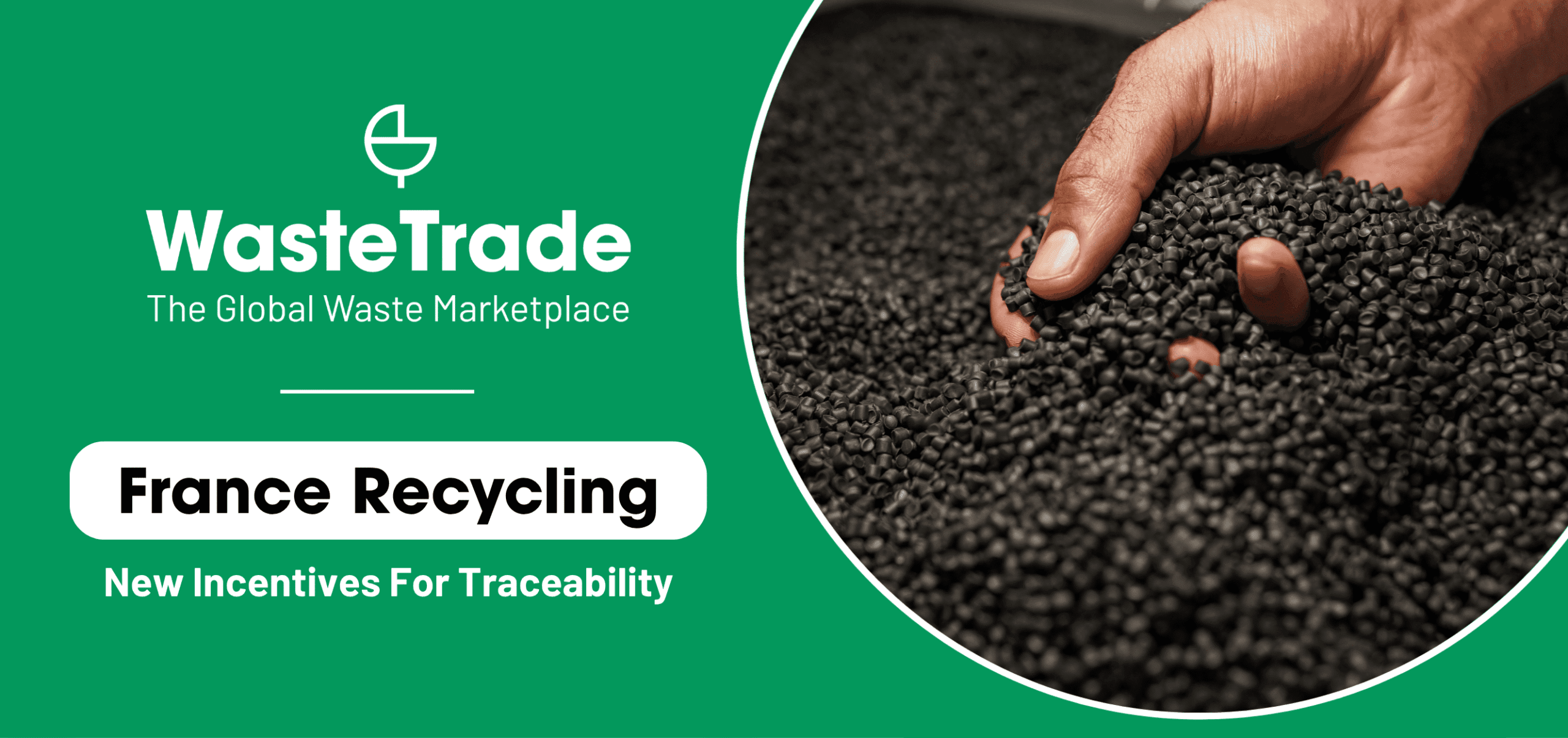
The France recycled plastic premium is turning traceable recycled polymer from a sustainability preference into a financial opportunity for producers placing eligible products on the French market.
France’s IMPR scheme, formally the Prime à l’incorporation de matière plastique recyclée, rewards producers that incorporate qualifying post-consumer recycled plastic into products covered by parts of the French Extended Producer Responsibility system. The premium starts at €450 per tonne, rises to €550 per tonne for closed-loop use, and reaches up to €1,000 per tonne from 2028 for selected hard-to-recycle resins in sensitive-contact packaging.
That figure will rightly draw attention from packaging manufacturers, converters, recyclers and brand owners selling into France. But the scheme is not simply a cash reward for buying recycled plastic. It is a reward for using the right recycled plastic, in the right application, with the right evidence behind it.
That distinction matters. Under IMPR, the value of recycled polymer depends not only on resin type, grade and price, but also on traceability, origin, processing route, proximity and documentation.
For businesses trading recycled plastics, that changes the commercial conversation.
France Recycled Plastic Premium Explained
The France recycled plastic premium works through the REP eco-contribution system. Producers already pay eco-contributions to approved eco-organisations for products they place on the French market. Under IMPR, qualifying recycled plastic incorporation can reduce those contributions. In some cases, the premium may reduce the contribution to zero or below.
In simple terms, France is giving producers a financial reason to use recycled plastic. But it is doing so through a regulated framework, not a loose voluntary incentive.
The premium applies to eligible post-consumer recycled plastic incorporated into covered products. It is designed to increase demand for recycled plastic, support circular material flows and reward supply chains that can prove what they are doing.
For producers and converters, the message is clear. Recycled content is no longer only a brand, procurement or carbon question. It is now a cost question too.
IMPR Premium Rates
The IMPR scheme sets out three main rates.
Open-loop recycled plastic, where the material comes from another REP stream, can receive a premium of €450 per tonne.
Closed-loop recycled plastic, where the material comes from the same REP stream, can receive €550 per tonne.
Selected hard-to-recycle resins in sensitive-contact packaging can receive €550 per tonne in 2026 and 2027, rising to €1,000 per tonne from 2028.
The structure is deliberate. France is not treating all recycled content as equal. It gives greater value to closed-loop circularity and to applications where incorporating recycled content is more difficult.
That creates a sharper market signal. A tonne of recycled polymer may have different financial value depending on where it came from, how it was processed, what product stream it belongs to and how confidently the buyer can prove those facts.
Recycled Plastic Demand In France
The premium is relevant to several core recycled polymer markets, including PET, PP, HDPE, LDPE and PS. These are not marginal materials. They are central to packaging, conversion and manufacturing supply chains across Europe.
The higher premium is more restricted. It applies only to selected hard-to-recycle resins and sensitive-contact packaging uses, so businesses should not assume every recycled plastic purchase will qualify. PVC recycled content is also excluded for household packaging, professional packaging and chemical containers.
Even with those limits, the direction is clear. France is placing financial value on recycled plastic that meets defined technical and compliance conditions.
That could strengthen demand for higher-quality recycled polymers, especially from suppliers that can demonstrate feedstock origin, resin identity, post-consumer status and suitable processing routes.
Traceable Recycled Plastic Is The Test
The premium does not apply just because a business buys recycled plastic. The material must be traceable, the eligible recycled fraction must be identifiable, and the recycled plastic must meet the scheme’s conditions.
The recycling process must also meet a minimum 50% mass yield, and the finished product must not include recognised recycling disruptors. The supply chain must be able to show where the material came from, how it moved through collection and sorting, where it was recycled, and where it was incorporated.
There is also a proximity rule. Collection, sorting, recycling and incorporation must fall within the required 1,500 km radius around France’s geographic centre, subject to the detailed rules of the scheme.
This is where IMPR becomes more than a procurement issue. A producer cannot simply ask whether recycled polymer is available at the right price. It must ask whether the material can support a claim.
Where was it collected? Where was it sorted? Which recycler processed it? Can the post-consumer origin be shown? Does the route meet the proximity rule? Can the documents link the material to the final product?
Those questions now sit close to the financial value of the material.
Digital Product Passports And Material Data
WasteTrade’s traceability work is especially relevant here because the platform is developing the kind of structured material data environment that schemes such as IMPR increasingly require.
WasteTrade’s Digital Product Passports are designed to turn material data into a traceable asset. They capture information such as origin, composition and lifecycle details in one place, allowing data to travel with the material as it moves through the supply chain.
That matters because IMPR eligibility depends on evidence. A recycled polymer stream becomes more commercially useful when the buyer can understand what it is, where it came from, how it has moved and whether its supporting information is consistent.
Digital Product Passports also help standardise and centralise information. In a market where buyers, recyclers, hauliers and compliance teams all need reliable data, that reduces the risk of fragmented paperwork and inconsistent claims.
For producers seeking the French recycled plastic premium, this is highly practical. Traceability is not a slogan. It is the ability to connect material identity, origin, movement and incorporation in a way that can support a commercial and regulatory decision.
DIWASS, Documentation And Compliance
WasteTrade’s brochure also highlights its DIWASS compliance capability. DIWASS introduces a digital system for waste shipment reporting, requiring accurate, standardised data for every movement. WasteTrade is built to capture and structure this data as part of the trading process.
That same logic applies to IMPR. Businesses need reliable information from the transaction itself, not a paperwork scramble after the material has moved.
WasteTrade’s platform supports automated processes and end-to-end documentation, helping businesses manage compliance more efficiently. Through Digital Product Passport data, WasteTrade can also support more reliable submissions and reduce the risk of manual errors where structured data is needed.
This is important for producers because the IMPR premium depends on the quality of the evidence chain. If origin, movement, composition or processing data is weak, the financial opportunity becomes harder to secure.
WasteTrade cannot replace a producer’s own legal, REP or eco-organisation checks. But it can help businesses build the kind of documented supply chain that gives those checks something solid to work from.
How WasteTrade Helps Buyers
For buyers , WasteTrade helps move recycled plastic sourcing away from informal enquiry and towards verified, structured procurement.
The marketplace gives businesses access to recycled and recyclable material streams from a network of vetted counterparties. Buyers can assess material availability, location, specification and commercial fit, while wanted listings allow companies to state exactly what they need and receive offers from relevant suppliers.
That is valuable under IMPR because buyers may need more than PET, PP or HDPE at a competitive price. They may need material that fits a specific application, falls within a relevant geography, comes with clearer origin information and can support documentation requirements.
WasteTrade also supports logistics through automated workflows and access to competitive haulage networks. Under a scheme with a 1,500 km proximity rule, logistics is not separate from compliance. The route matters.
How WasteTrade Helps Recyclers
For recyclers and sellers, IMPR creates a stronger reason to bring well-documented material to market.
Producers looking to benefit from the premium will place more value on suppliers that can show resin type, feedstock origin, post-consumer status, processing location and material quality. A recycler that can provide stronger evidence may have a commercial advantage over one competing only on price.
WasteTrade helps sellers reach verified buyers through a marketplace built around due diligence, compliance and supply chain visibility. Rigorous onboarding checks ensure buyers and sellers are vetted, verified, compliant and approved to trade.
That matters because trust is part of the transaction. Buyers seeking IMPR-ready supply will want confidence not only in the material, but in the company behind it.
WasteTrade is also developing AI-driven material recognition technology to improve the speed, accuracy and consistency of material identification. By reducing reliance on manual processes, this can help lower the risk of mislabelled material and support more reliable trading outcomes.
Traceability Is Becoming Commercial Value
France’s IMPR scheme shows where the recycled plastics market is heading.
Recycled content is becoming more valuable when it can be evidenced. The market is moving towards proof of origin, proof of composition, proof of movement, proof of processing and proof of incorporation.
That puts pressure on weak supply chains, but it also rewards better ones. Businesses that can connect recycled polymer to reliable data, verified counterparties and documented logistics will be better placed to access financial incentives such as the France recycled plastic premium.
WasteTrade sits directly in that space. Its marketplace connects supply and demand, its onboarding process strengthens trust, its Digital Product Passports structure material data, its DIWASS-ready systems support standardised reporting, and its logistics tools help businesses manage the route behind the material.
For producers, converters and recyclers, the lesson is straightforward. The value of recycled plastic is no longer held only in the polymer itself. It is held in the evidence that travels with it.
Companies that want to benefit from IMPR need traceable recycled polymer supply, not just recycled polymer. WasteTrade helps build the trading environment to make that possible.