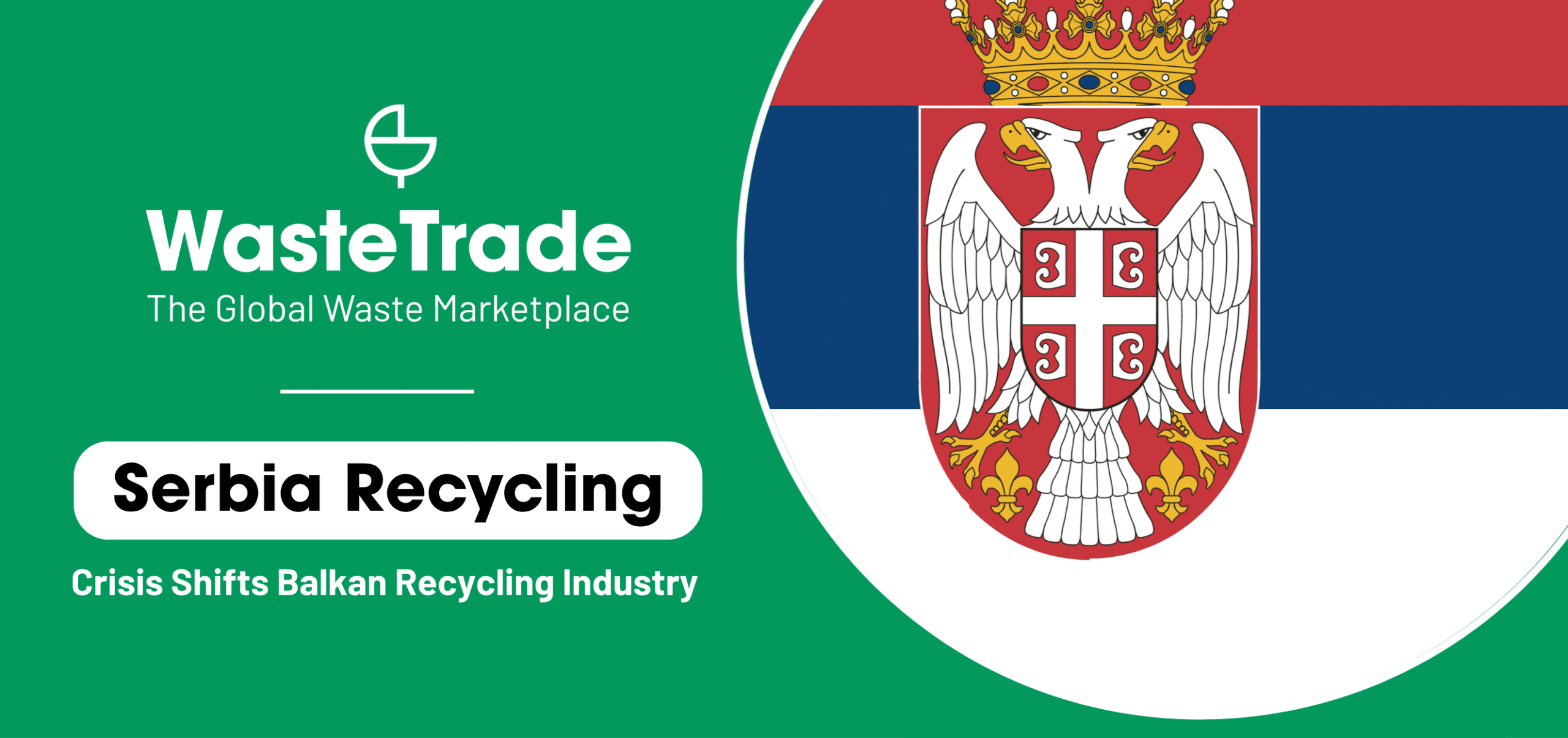
Serbia recycling entered one of its most unstable periods in recent memory on 1 January 2026, when the country’s incentive framework for waste treatment effectively disappeared overnight, throwing major parts of the recycling sector into uncertainty and exposing deeper weaknesses across the wider Balkans recycling market.
For years, recycling operators throughout the Western Balkans have worked inside fragile systems shaped by changing regulation, uneven enforcement and inconsistent funding structures. Serbia’s latest disruption has dragged those pressures into full view.
The consequences arrived immediately.
Companies handling tyres, batteries, oils, refrigerators and waste electrical equipment suddenly faced a market where the financial structure underpinning collection and treatment no longer existed in its previous form. Some recyclers stopped accepting material altogether. Others warned that stockpiling and illegal dumping could follow if a replacement mechanism failed to emerge quickly enough.
But the Serbia recycling crisis is not simply a Serbian story.
It is a warning about what happens when environmental ambition moves faster than commercial infrastructure.
Across the Western Balkans, governments are under mounting pressure to align with EU environmental standards, improve recycling rates and modernise waste legislation. Yet many still lack the processing capacity, trading networks and logistics systems needed to support those ambitions at scale.
That disconnect is becoming one of the defining challenges in Balkans recycling.
It is also creating a major shift in how recyclable material moves through the region, and why companies like WasteTrade are becoming increasingly important within emerging cross-border recycling markets.
Serbia Recycling Incentives Collapse Into Uncertainty
The roots of the crisis lie in Serbia’s new Waste Management Law, adopted in late 2025 as part of the country’s wider environmental alignment efforts.
The legislation itself aimed to modernise Serbia’s waste framework and bring the country closer to EU standards around recycling, recovery and producer responsibility. But during the transition, the previous regulation governing recycling incentives was abolished, creating a sudden financial vacuum from the start of 2026.
For large parts of the recycling sector, that vacuum proved immediately destabilising.
Many difficult waste streams remain commercially weak even under functioning market conditions. Tyres, batteries, oils and WEEE often require expensive treatment processes with limited recovery margins. Incentive structures helped bridge that gap.
Without them, the economics changed overnight.
Industry groups warned that operators could no longer price material confidently, commit to intake volumes or invest in treatment capacity under conditions of legal and financial uncertainty.
The impact extends far beyond individual recyclers.
Serbia’s recycling sector directly supports thousands of jobs while underpinning much wider supply chains connected to collection, transport and downstream processing.
Once material stops moving through formal channels, environmental risk rises quickly.
That matters across the Balkans recycling market because Serbia is not an isolated system. Material, processors, buyers and logistics networks already operate regionally, even if legislation still does not.
Serbia Recycling Exposes a Structural Balkans Recycling Weakness
The deeper issue is not subsidies alone.
The Serbia recycling crisis exposes how dependent large parts of the Western Balkans remain on unstable frameworks without fully developed market infrastructure beneath them.
That tension exists across the region.
Countries including Bosnia and Herzegovina, North Macedonia, Kosovo and Albania are all under growing pressure to align with EU environmental requirements under Chapter 27 accession negotiations. Recycling targets are increasing. EPR obligations are expanding. Collection systems are gradually improving.
Yet operational reality remains uneven.
Municipal recycling rates across much of the region remain extremely low. Landfill dependence remains widespread. Domestic processing infrastructure still lags far behind Western Europe.
At the same time, recyclable material volumes are expected to rise sharply over the next decade as legislation tightens and collection improves.
That creates an uncomfortable contradiction.
Governments are pushing more material into formal recycling systems before the region has fully built the infrastructure capable of handling it efficiently.
Something has to bridge that gap; increasingly, that bridge is cross-border trade.
Balkans Recycling Is Becoming Increasingly Regional
For years, recycling discussions in the Western Balkans focused heavily on collection rates.
But collection alone solves very little if there is nowhere commercially viable for material to go afterwards.
This is where the Balkans recycling market is changing rapidly.
A recycler in North Macedonia may generate material that cannot be processed domestically. A processor in Serbia may require feedstock from neighbouring countries to remain economically viable. A business in Bosnia and Herzegovina may improve separation rates faster than local infrastructure can absorb the resulting volumes.
In each case, regional movement becomes essential.
WasteTrade has recognised this shift early through its growing presence across the Balkans, particularly in North Macedonia, where the company has been building relationships throughout the regional recycling sector.
That regional positioning matters because the Western Balkans do not operate as neatly separated waste markets anymore.
Material already moves across borders. Buyers source internationally. Processors depend on external feedstock. Logistics routes increasingly determine commercial viability.
The problem is that regulation has not fully caught up with market reality.
Cross-Border Waste Trading Remains Fragmented
Moving recyclable material across Balkan borders remains far more complicated than many outside the region realise.
Each country operates within different approval systems, evolving EPR structures and varying enforcement standards. Permit timelines remain inconsistent. Administrative delays can alter market conditions before shipments are approved.
For recyclers and traders, those delays create genuine commercial risk.
WasteTrade’s work in the Balkans increasingly revolves around solving precisely these operational bottlenecks through verified buyers, logistics coordination and compliant cross-border trading relationships.
That is becoming more important as environmental regulation accelerates.
The Western Balkans 6 Chamber Investment Forum has already called for greater regional harmonisation of EPR systems covering packaging, textiles and metal waste streams. Without greater alignment, moving recyclable material efficiently across the region will remain difficult.
And yet regional movement is exactly what the market increasingly requires. That contradiction sits at the centre of the current Balkans recycling landscape.
Serbia Recycling Shows Why Infrastructure Matters More Than Policy Alone
The Serbia recycling crisis also highlights a broader truth about emerging recycling markets.
Legislation alone does not create a functioning recycling economy. Infrastructure does.
So do buyers.
So do transport routes, processing capacity and commercial confidence.
Across the Balkans, governments are introducing more ambitious waste legislation while private sector operators still struggle with fragmented logistics, inconsistent downstream demand and underdeveloped domestic processing networks. This is why platforms such as WasteTrade are becoming increasingly relevant beyond simple buying and selling.
The role is evolving into something much broader: connecting recyclers with verified downstream partners, supporting compliant material movement and helping operators navigate regional complexity that many Western European markets solved years ago.
That operational layer becomes especially important during periods of instability.
When domestic conditions become uncertain, access to trusted international buyers and alternative trading routes can determine whether recyclable material continues moving or ends up stranded.
Bosnia and Herzegovina Could Become a Major Feedstock Market
The wider Balkans recycling market is already moving into a new development phase.
Bosnia and Herzegovina offers one of the clearest examples.
The country recently secured major World Bank funding aimed at improving waste collection, landfill rehabilitation and recycling infrastructure. Over time, those improvements should increase separation rates and recoverable material volumes significantly.
But increased collection creates another question: where will all that material go?
Domestic processing capacity across much of the region still remains limited. That means improved collection systems are likely to increase demand for export routes, regional buyers and cross-border processing partnerships.
For companies active in recycling logistics and commodity trading, that creates substantial long-term opportunity.
WasteTrade’s growing network across the Balkans places the company directly within that transition, particularly as more recyclers and manufacturers begin searching for stable regional supply relationships rather than purely domestic solutions.
The Informal Sector Still Drives Balkans Recycling
One of the least understood aspects of Balkans recycling remains the role of the informal sector.
Across much of the region, informal collectors still recover significant volumes of recyclable material, particularly higher-value streams such as plastics, metals and packaging waste.
In Serbia especially, informal collection networks remain deeply embedded within the recycling chain. That creates a complex balancing act as governments attempt to formalise systems under EU alignment pressures.
The reality is that informal networks continue to fill collection gaps that municipal systems often cannot.
Companies entering the region without understanding that dynamic frequently struggle.
WasteTrade’s approach in the Balkans has placed strong emphasis on regional relationships, local communication and direct engagement with operators on the ground rather than treating the market purely as a remote digital trading exercise.
That matters because trust remains one of the most valuable commercial assets in emerging recycling markets.
North Macedonia Reflects the Future of Balkans Recycling
North Macedonia increasingly reflects the direction the wider region is heading.
The country continues strengthening waste legislation and EPR structures while simultaneously facing growing pressure around processing capacity and specialist waste management.
Collection systems are improving, but much of the material generated still requires access to external markets and regional buyers.
For a smaller landlocked economy, cross-border recycling relationships become especially important.
WasteTrade’s Balkans growth strategy , led from North Macedonia, reflects a recognition that future recycling markets in the region will depend less on isolated national systems and more on interconnected regional trading networks.
That shift is already happening.
As industrial investment expands across the Balkans, new waste streams will emerge alongside rising pressure for compliant downstream management. Batteries, plastics, industrial scrap and packaging materials will all require more sophisticated handling structures than many domestic systems currently provide.
Serbia Recycling Marks a Turning Point for Balkans Recycling Industry
The Serbia recycling crisis should be viewed as more than a temporary regulatory disruption.
It marks a turning point.
The Western Balkans recycling sector is entering a period where legislation, infrastructure and market development are no longer moving at the same speed. Collection systems are improving. Environmental pressure is intensifying. Recyclable material volumes are rising.
But stable regional trading infrastructure is still catching up. That creates volatility.
It also creates opportunity for companies capable of connecting fragmented markets, verified buyers and compliant logistics systems across borders.
WasteTrade’s growing presence throughout the Balkans reflects a broader shift already underway within the regional recycling economy. As the market becomes more interconnected, the ability to move recyclable material efficiently between countries may become just as important as collecting it in the first place.
The Serbia recycling crisis has exposed how fragile parts of the current system remain.
It has also revealed where the future of Balkans recycling is likely heading next.